Craniosacral Therapy for Babies, Older Kids, and Teens
Gentle Craniosacral Therapy for Babies, Children & Teens in Portland, Oregon
Craniosacral therapy is a gentle, hands-on approach to bodywork that can be adapted to the needs of infants, children, and teenagers. Each session is individualized, with attention to the child’s age, comfort, temperament, and natural patterns of movement.
At Alice Palmeri LMT in Southwest Portland, I provide a calm, supportive environment where children are welcomed just as they are. Sessions are never about making a child stay still or follow a prescribed routine. Instead, I work at the child’s pace, paying attention to their cues and adjusting the session to what feels comfortable for them.
Parents are an important part of this process. You are welcome to stay close, hold your baby, ask questions, and share observations about your child’s needs and experiences.
Craniosacral Therapy for Infants
The first months of life bring enormous changes for babies and their families. Parents may notice feeding difficulties, unsettled behavior, trouble sleeping, or difficulty getting comfortable. Sometimes these concerns arise alongside a history of a difficult birth, feeding challenges, or a diagnosed or suspected tongue-tie.
Infant craniosacral sessions offer a gentle, attentive setting in which to focus on your baby’s comfort and individual needs.
Parents commonly seek infant craniosacral therapy when their babies experience:
Feeding challenges: Concerns involving latching, feeding coordination, or comfort during feeding.
Tongue-tie concerns: Babies with a diagnosed or suspected tongue-tie may have additional feeding-related concerns. Craniosacral therapy does not release or correct a tongue-tie, but gentle bodywork may be considered as a complementary part of a broader care plan.
Fussiness and difficulty settling: For babies who seem uncomfortable, have difficulty relaxing, or are hard to soothe.
Colic-related concerns: Parents looking for gentle, supportive care while navigating periods of frequent crying or unsettled behavior.
Sleep difficulties: Babies who have trouble settling, seem restless, or have difficulty getting comfortable.
Birth and early adjustment: Parents who would like their baby’s birth history and early experiences to be considered as part of an individualized session.
Every baby is different. Rather than assuming that one concern has one cause, I take time to listen to your observations and learn what you are noticing about your baby.
A Baby-Led Approach to Each Session
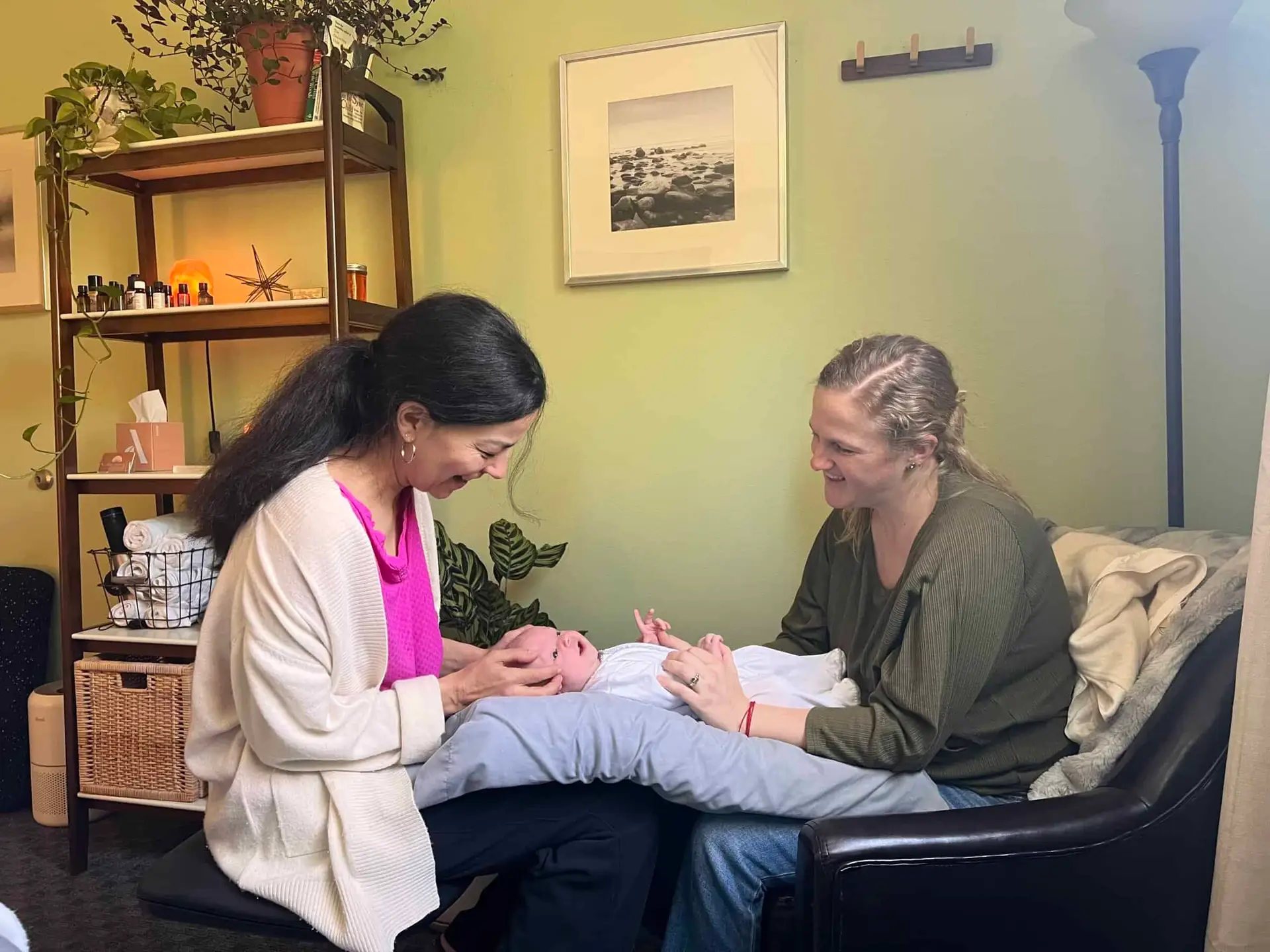
Infants do not need to lie still or remain on a treatment table to receive care. Your baby may be held in your arms or rest comfortably nearby, depending on their age and preferences. We can pause for feeding, cuddling, diaper changes, or simply taking a break.
I pay attention to your baby’s natural movements, positioning, comfort, and responses throughout the session. The work is gentle and adapted to the baby’s cues rather than following a fixed sequence of techniques.
We can also talk about your baby’s feeding patterns, sleep, temperament, birth history, and the concerns that brought you in. Your observations as a parent are valuable, and they help guide the session.
Craniosacral Therapy for Babies, Children & Teens
As children grow, their needs and ways of communicating change. Older babies may be curious and active, while toddlers and school-age children may prefer to move around, play, talk, or take time to become comfortable in a new setting.
Sessions are adapted to the child’s developmental stage, personality, and comfort level. I use a gentle approach that respects each child’s boundaries and allows them to participate in ways that feel natural to them.
Parents may seek craniosacral therapy for children who:
Have difficulty settling or relaxing
Seem uncomfortable or have difficulty finding comfortable positions
Are sensitive to touch or changes in their environment
Have experienced a stressful or difficult period
Would benefit from quiet, individualized bodywork as part of their overall wellness routine
For children and teens, sessions may incorporate gentle craniosacral techniques alongside other age-appropriate bodywork approaches, depending on the child’s needs and comfort.
What Makes Pediatric Craniosacral Sessions Different?
Working with babies and children requires flexibility, patience, and an understanding that every child communicates differently.
A session may look quite different from one child to another. Some babies relax while being held by a parent. Older children may prefer to move around or take time to become familiar with the room. Some children enjoy quiet, while others need conversation or reassurance.
There is no expectation that a child behave a certain way or remain still throughout the appointment. I follow the child’s cues and adjust the session accordingly.
My goal is to create a positive, respectful experience in which your child feels safe, comfortable, and supported.
Working Alongside Your Child’s Healthcare Team
Craniosacral therapy is a complementary form of bodywork. It is not a substitute for medical evaluation or treatment, and it does not diagnose or correct medical conditions.
Feeding difficulties, suspected tongue-tie, persistent crying, sleep concerns, and other ongoing symptoms deserve appropriate evaluation by your child’s pediatrician and, when relevant, a qualified lactation consultant, feeding specialist, or other healthcare professional.
I welcome a collaborative approach and encourage parents to continue working with their child’s healthcare providers. Craniosacral therapy can be considered as a complementary wellness service when appropriate.
What to Expect at Your Child’s Appointment
Your first appointment includes time to talk about your child’s history, your concerns, and what you hope to get from the session. For infants, this may include discussion of birth history, diagnosed issues, feeding, sleep, and patterns of fussiness or comfort.
You remain with your child throughout the appointment. Babies can be held, fed, or comforted as needed. Most babies prefer to be held or nurse during their session. Older children can take breaks and become familiar with the space at their own pace.
There is no single way a session needs to unfold. The approach is guided by your child’s comfort and individual needs.
Gentle Craniosacral Therapy in Southwest Portland
I provide craniosacral therapy for infants, babies, children, and teens at Alice Palmeri Massage Therapeutics in Southwest Portland, Oregon. Families visit from throughout the Portland area, including Beaverton, Tigard, and Lake Oswego.
If you have questions about whether craniosacral therapy may be appropriate for your child, I welcome you to get in touch. We can talk about your concerns and whether this gentle, individualized approach may be a good fit.
What is craniosacral therapy and how does it work?
Craniosacral therapy is a gentle and wholistic form of manual therapy that works to free up restrictions in the body. CST creates movement, helps cerebral spinal fluid flow, and can help regulate the central nervous system. Studies have shown that CST improves many common conditions that affect infants.
Being born is an intense experience in many ways, for both baby and parents. For the baby, it’s head has to narrow enough to be born. Luckily, the cranial bones of a babies’ head are mobile and can glide around to reshape to get the job done. These bones often override each other in order to narrow and fit though. As a result, the baby’s head does not always return to its normal shape right away. Sometimes the cranial nerves can also be impacted, which can cause some issues like those previously listed. After CST, there can be improvement in muscle, lymphatic, blood and nerve function.
CST will help a baby’s body and mind recover so they can begin discovering the world and their family.
What can I expect during my baby’s CST treatment?
Most babies and older children enjoy their CST sessions. Sessions last from 45-60 minutes depending on the individual. Your baby can sit in your lap, be held by you, your partner, or us. Sometimes, babies prefer to nurse or even nap through part or all of the craniosacral treatment. Any way the baby finds to relax is ideal for CST. The touch involved during their session will be very light and gentle.
Toddlers and older kids may feel restless and move around, craniosacral therapy for babies and children can be done on mobile kids too. In some cases, we will play during their treatment. Not to worry, CST can be dynamic, fun, and just as beneficial.
Many parents are worried CST will be painful. Most babies really enjoy themselves and many even fall asleep. The touch used during the session is very gentle and will not hurt. We will show you the pressure used during our session before working with your baby.
Afterwards, your baby may be sleepy, this is part of the healing process and perfectly normal. Sometimes, a baby may cry to relieve stress, this too is therapeutic and should soon subside.
Can I use insurance for CST for my baby or older child?
Yes! CST is considered a type of massage therapy. So if your insurance covers massage therapy, we are happy to bill both Regence Blue Cross/Blue Shield and Providence. Please check with your insurance before scheduling to make sure massage therapy is covered and let us know if your insurance requires a referral.
Additionally, please fill out our intake form and indicate that you would like to use insurance in the “notes” section. Use your child’s name when making the appointment, not a parent’s name, and please complete all sections.
Of course, there is no guarantee of insurance payment and guardians will be financially responsible if a claim is not honored by their insurance. If you are out of network, we are happy to provide a “superbill” for you to send in to your insurance for reimbursement.
Book Your Session to Begin Healing Today
Every session is tailored to your particular needs in a friendly inclusive environment. Your comfort and healing are our main priority.