
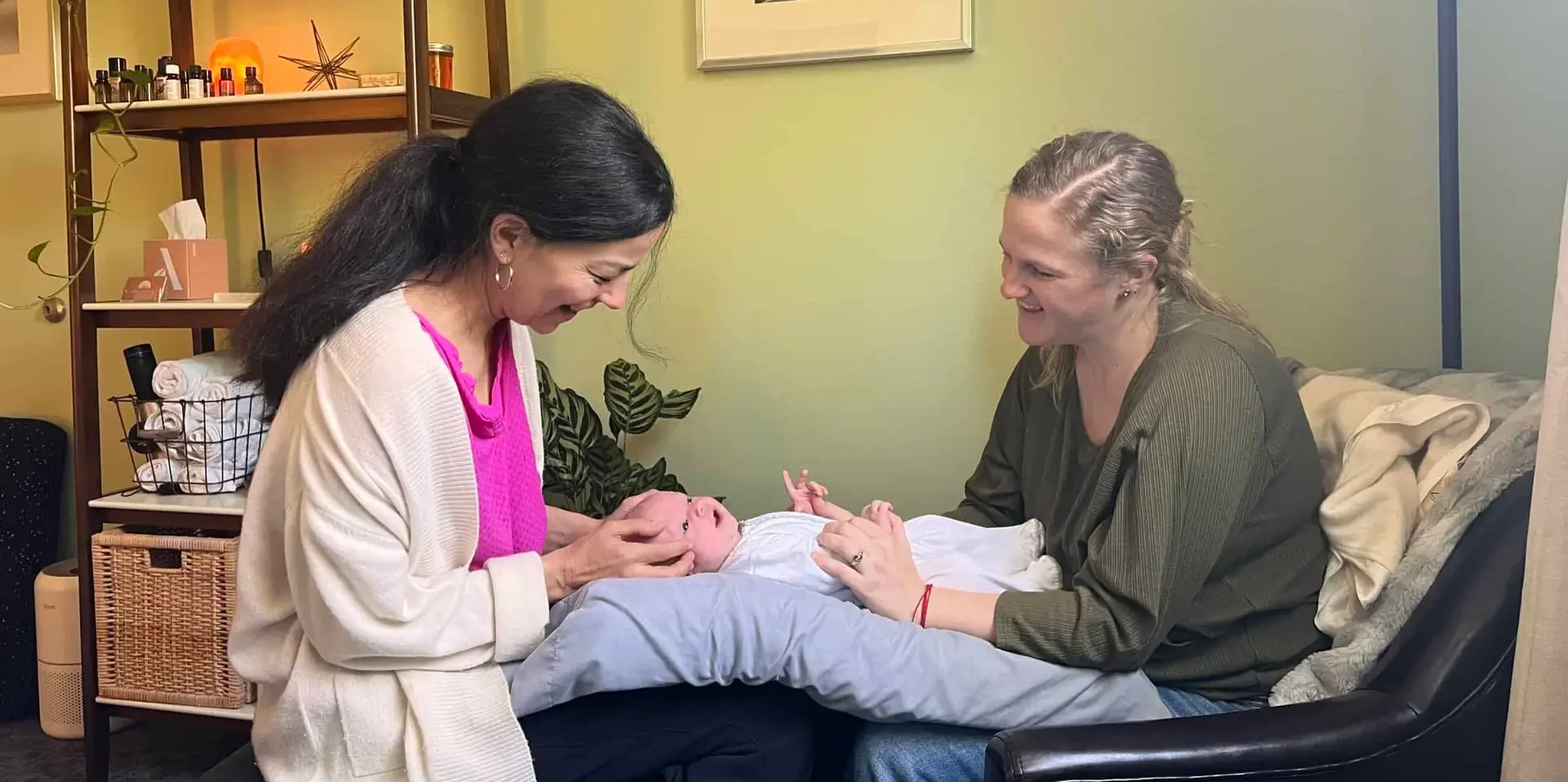
Gentle, Individualized Care for Newborns and Infants
The first months of a baby’s life are full of changes and new experiences. While most babies adjust naturally, some seem to have a harder time getting comfortable, settling, or finding ease in their little bodies.
Craniosacral therapy for babies is a gentle, hands-on approach that may help support your baby’s comfort and relaxation. It uses light, carefully applied contact to work with areas of tension around the head, neck, and body.
At Alice Palmeri LMT, we take a gentle, individualized approach to caring for infants. Alice has extensive training in craniosacral therapy, along with advanced training in pediatric and infant massage. This background allows her to draw from several gentle bodywork approaches and adapt each session to your baby’s individual needs, temperament, and stage of development.
Our goal is simple: to provide a calm, supportive experience for your baby while helping you feel informed and comfortable throughout the process. Every question is an important one.
1. What is craniosacral therapy for infants and newborns?
Craniosacral therapy (CST) is a gentle form of bodywork that focuses on relaxation and areas of tension throughout the body, particularly around the head, neck, spine, and pelvis. One of the goals of our sessions with infants is to help ease areas of tension and restrictions in the fascia and muscles.
Babies experience a lot of physical changes before, during, and after birth. Their bodies are adapting to a completely new environment, and the birth process can be physically demanding. Some babies may appear to hold tension or have difficulty getting comfortable in certain positions.
During a craniosacral therapy session, the therapist uses very gentle contact and slow, subtle techniques. There is no forceful manipulation or sudden movement. Many babies become very relaxed during their sessions, and some even fall asleep.
Think of it as a quiet opportunity for your baby to relax while receiving attentive, individualized care.
2. Why might parents consider craniosacral therapy for their baby?
Every baby is different. Some parents seek infant craniosacral therapy because their baby seems uncomfortable, has difficulty settling, or appears to prefer certain positions.
You might consider exploring craniosacral therapy if you notice:
Head-turning preferences: Your baby consistently prefers looking in one direction.
Plagiocephaly: Your baby has a flat spot on their head that has been diagnosed by a doctor.
Body tension: Your baby seems particularly stiff or uncomfortable when changing positions.
Feeding challenges: Your baby has difficulty getting comfortable during breastfeeding or bottle-feeding or may have latch issues.
Difficulty sleeping: Your baby seems restless or has trouble sleeping, even when they are tired and their basic needs are met.
Birth-related tension: Your baby experienced a long or difficult delivery, assisted delivery, or C-section.
General discomfort: Your baby frequently arches, stretches, or seems uncomfortable in certain positions.
Tongue-tie revision support: Your baby is preparing or has just had a tongue-tie revision.
These observations and issues don’t necessarily mean something is wrong. Babies have different temperaments, preferences, and developmental patterns.
Craniosacral therapy may offer additional support for relaxation and body comfort. It is not a way to diagnose the cause of these concerns, and persistent feeding, movement, or health concerns should also be discussed with your pediatrician.
3. Can craniosacral therapy help with breastfeeding, tongue-tie, or plagiocephaly?
Parents often discover craniosacral therapy while looking for additional support with breastfeeding difficulties, tongue-tie, or positional head preferences.
These concerns can sometimes overlap with areas of physical tension or difficulty getting comfortable. Gentle bodywork may be considered as one part of a broader approach to supporting your baby.
Craniosacral therapy for breastfeeding or bottle-feeding
Some babies have difficulty getting comfortable during nursing or bottle-feeding. Parents may notice that their baby prefers turning their head in one direction, has difficulty maintaining a comfortable feeding position, or seems tense around the jaw, neck, or shoulders.
Craniosacral therapy for breastfeeding may be explored as a complementary approach to encourage relaxation and comfort while nursing or bottle-feeding.
If breastfeeding or bottle-feeding is uncomfortable or your baby is having difficulty latching, working with an International Board Certified Lactation Consultant (IBCLC) can also be very helpful. Craniosacral therapy does not replace a professional assessment of feeding.
Craniosacral therapy for tongue-tie
Tongue-tie can affect the way some babies move their tongues and may contribute to breastfeeding or bottle-feeding difficulties.
Some families explore craniosacral therapy for tongue-tie as complementary bodywork, particularly when they notice tension around the jaw, face, and neck. We work with other Portland practitioners who refer for pre and post tongue-tie release support.
To be clear, craniosacral therapy does not release or correct a tongue-ties An appropriate evaluation by a qualified healthcare professional and lactation consultant are important when tongue restriction is suspected.
Craniosacral therapy for plagiocephaly (flat head syndrome)
Plagiocephaly refers to flattening on one area of a baby’s head, often associated with positioning preferences or spending time with the head turned in one direction.
Parents sometimes seek craniosacral therapy for plagiocephaly when their baby also seems to have difficulty turning their head comfortably or prefers one position.
Gentle bodywork may be explored to support relaxation and comfort around the head and neck. However, craniosacral therapy does not reshape a baby’s skull or replace medical evaluation. Your pediatrician can assess head shape and recommend appropriate positioning guidance, physical therapy, or other care when needed. We are here to support those efforts.
4. Can craniosacral therapy help with baby sleep and settling?
Sleep is one of the biggest adjustments for both babies and parents. Some babies seem to settle easily, while others have a harder time relaxing, finding comfortable positions, or transitioning into sleep. Needless to say, it can be very difficult for new parents whose baby is waking every 30 minutes.
Parents sometimes explore craniosacral therapy for baby sleep when their little one seems restless, has difficulty settling, or appears uncomfortable.
Craniosacral therapy focuses on gentle relaxation and areas of physical tension. Some parents report that their babies seem more relaxed or settled following a session. Many parents report that their babies sleep longer after receiving craniosacral therapy. Many babies even fall asleep during their treatment.
Depending on your baby’s individual needs, sessions may focus on supporting:
Relaxation through the head, neck, and shoulders.
Greater comfort when turning the head in different directions.
Ease and comfort during everyday positioning.
Relaxation around the jaw and face.
Overall body comfort and releasing areas of restriction.
It is important to remember that babies have different sleep patterns, and frequent waking is a normal part of infant development. Craniosacral therapy is not a treatment for sleep disorders and works differently for every infant.
Our goal is to support your baby’s comfort and relaxation, so everyone can have a better night of sleep.
5. What happens during an infant craniosacral therapy session?
Your baby’s comfort always comes first. Sessions are gentle, relaxed, and adapted to your baby’s needs and responses. The pressure used is equivalent to the pressure of a penny, it’s very light.
During an appointment:
Your baby can remain fully clothed.
You are welcome to stay close and participate throughout the session. Many moms chose to nurse of bottle-feed during the session.
Most babies are most comfortable in their parents’ arms. Your baby may also lie comfortably on the treatment table depending on their needs.
Gentle contact is used around the head, neck, back, and other areas as appropriate.
Alice may incorporate other forms of gentle bodywork, including infant massage, depending on your baby’s needs.
We’re very flexible, feeding, diaper changes, and breaks are welcome whenever needed.
There is no expectation that your baby will remain still, asleep, or even quiet during the appointment. Babies are welcome to wiggle, fuss, cry, feed, or take a break.
We follow your baby’s cues and never force a position or technique. The session is about meeting your baby where they are that day, and Alice is very good at working around a squiggly or fussy baby.
6. What should I look for when choosing a craniosacral therapist for my baby in Portland?
Not all craniosacral therapy training is the same, and experience working with adults does not necessarily translate to experience working with infants.
In the Portland area, practitioners may have very different levels of training in craniosacral therapy. Some may have completed only a short introductory course, while others have pursued extensive education and specialized training. Because babies require such a gentle and individualized approach, it is worth asking about a practitioner’s specific training and experience with infants.
Some helpful questions to ask include:
What formal training have you completed in craniosacral therapy?
Have you received specialized training in working with infants and newborns?
How much experience do you have working with babies?
Do you incorporate other gentle bodywork approaches when appropriate?
How do you adapt sessions to a baby’s comfort and cues?
Alice has pursued extensive craniosacral therapy education through the Carol Grey School of Craniosacral Therapy, in addition to advanced pediatric and infant massage training.
Her approach draws on this background and may incorporate different forms of gentle bodywork depending on what seems most appropriate for each baby.
We believe parents deserve to feel comfortable asking questions and understanding the training and experience of the person caring for their baby.
Craniosacral therapy should always be considered complementary care, not a substitute for medical evaluation or treatment. If your baby has persistent feeding difficulties, poor weight gain, unusual movement patterns, or other health concerns, you should seek evaluation from your pediatrician.
There is no one-size-fits-all treatment plan. Some families come for a single session, while others choose to return depending on their baby’s needs and their experience. We will discuss realistic goals and recommendations without pressure to schedule ongoing appointments.
Gentle Craniosacral Therapy for Babies in Southwest Portland
Those early months are precious, and navigating the many changes of newborn life can sometimes feel overwhelming. You don’t have to have all the answers or know exactly what your baby needs before reaching out.
At Alice Palmeri LMT, we offer gentle, individualized craniosacral therapy for babies and newborns in Southwest Portland, Oregon. With extensive craniosacral therapy training and advanced pediatric and infant massage education, Alice brings a thoughtful, relaxed approach to caring for little ones.
Whether you’re exploring craniosacral therapy for breastfeeding, looking for additional support with your baby’s comfort, or simply curious about gentle bodywork for your newborn, we welcome your questions.
Contact us to learn more or schedule an infant craniosacral therapy appointment.